
Canada’s Federal Plastics Registry (FPR) requires producers to report every year on the plastic they put on the Canadian market. It was created by a notice issued under section 46 of the Canadian Environmental Protection Act, 1999 (CEPA), published in the Canada Gazette on April 20, 2024. Reporting began in September 2025 with data for the 2024 calendar year.
2026 Update: Environment and Climate Change Canada (ECCC) has formally postponed Phases 2 and 3 of the Registry. A notice amending the original notice, published in the Canada Gazette on March 14, 2026, limits reporting for the 2025 and 2026 calendar years to the Phase 1 categories.
Two Phase 1 deadlines have now passed: September 29, 2025 for 2024 data and September 29, 2026 for 2025 data.
The next deadline is September 29, 2027 for 2026 data.
Who FPR Reporting Applies To
The notice as a whole names four groups:
Resin manufacturers and importers
Producers of plastic products
Generators of plastic waste at ICI facilities
Plastics service providers.
For the 2024, 2025 and 2026 calendar years, however, only producers of packaging, EEE and single-use or disposable products destined for the residential waste stream must report.
Who Is a Producer?
The producer is the brand owner resident in Canada. If the brand owner is not in Canada, the first resident person to import or manufacture the product is the producer. If there is no resident importer or manufacturer, it is the first resident person who supplies the product to the consumer. ECCC notes the definition is aligned with provincial EPR producer definitions, so a company with provincial EPR obligations very likely has FPR obligations too.
Exemption: Producers who manufacture, import or place less than 1,000 kg of plastic in packaging and products on the market in a calendar year are exempt. The threshold counts only the plastic in the items, not the whole item, and it is calculated nationally across all provinces.
Canada's FPR Reporting Requirements
Companies required to report for the 2024, 2025 and 2026 calendar years are producers who manufacture, import or place the following on the market in Canada, where the items are destined for the residential waste stream:
Plastic packaging
Electronic and electrical equipment
Single-use or disposable products
Resin manufacturers, plastics service providers, and generators of plastic waste at industrial, commercial or institutional (ICI) facilities no longer have to report for the 2025 and 2026 calendar years. Their obligations have been pushed to the new notice which has not yet been released.
Covered producers must report, for each resin in their packaging and products:
Category and subcategory, using the lists in Schedule 1 of the notice.
Resin type, identified by its North American Product Classification System (NAPCS) code.
Resin source (virgin fossil-based, post-consumer recycled, post-industrial recycled, or bio-based).
Quantity in kilograms manufactured in Canada, imported into Canada, and placed on the market in Canada and in each province and territory.
Calculation method used to arrive at those quantities.
ECCC’s Phase 1 reporting guide describes three calculation methods that producers can use, and it also accepts methods developed for provincial EPR programs as long as the method is identified in the submission:
Specific Component Identification Method, which weighs the plastic components of each product directly.
Average Bill of Materials (ABOM) Method, which averages plastic content across a group of similar products.
Fixed Factor Calculation Method, which applies a standard conversion factor to production or sales data.
Reporting Beyond 2027
ECCC is developing requirements for reporting beyond 2027 that will be released in a future notice. Expanded requirements add new groups that must report plus several additional product categories.
| Data Years | Who Must Report | Product Categories |
|---|---|---|
| 2024 to 2026 | Producers | Plastic packaging, electronic and electrical equipment, and single-use or disposable plastic products that end up in household waste |
| Beyond 2027(planned) | Producers, plus resin manufacturers and importers, businesses that generate plastic waste at their facilities, and companies that collect, recycle, or dispose of plastic | The current three categories, plus plastic resins and six more categories: agriculture and horticulture, tires, transportation, construction, fishing and aquaculture, and textiles and apparel |
Planned requirements also add data on plastic waste and what happens to it at end of life. They will be set in a new ECCC notice covering 2027 to 2029, which has not yet been published.
How to Report
Submissions are made through ECCC’s online reporting platform. Producers can designate a producer responsibility organization or another person to report on their behalf, but the producer remains responsible for the report’s accuracy.
Under subsection 46(8) of CEPA, anyone subject to the notice must keep copies of the submitted information, including calculations and measurements, for three years from the date the information was required to be submitted. The Minister intends to publish part of the collected information.
A confidentiality request can be made for information that meets the criteria in section 52 of CEPA (for example, trade secrets or information whose disclosure would cause material financial loss), with a written rationale.
Penalties for FPR Noncompliance
Fines range from a maximum of $25,000 for an individual convicted on summary conviction to a maximum of $500,000 for a large corporation convicted on indictment, and the maximums double for a second or later offence. Offences include failing to report, reporting late, and knowingly submitting false or misleading information.
Next Steps for Federal Plastics Registry Reporting
Gather 2026 data now: Reports due on September 29, 2027 cover the same categories, data fields, and residential-waste-stream scope as in the first two reporting years.
Communicate with suppliers: You will need to obtain resin types, sources, and weights from them. You can get information on foreign suppliers from the ECCC Government of Canada letter.
Track the new notice: The upcoming 2027-2029 notice will set the scope and timing for postponed categories as well as ICI waste and end-of-life data.
How Snaplinc Can Help
Compliance is time-consuming and complicated. Snaplinc provides comprehensive compliance services to take the guesswork out of your sustainability strategy. Our team supports clients with:
Data Collection and Management: Gathering and organizing the necessary data on plastic resins and products.
Regulatory Compliance Audits: Confirming that your data meets the notice’s requirements.
Reporting Assistance: Preparing and submitting accurate reports through ECCC’s online reporting system.
Confidentiality Requests: Submitting confidentiality requests to protect trade secrets.
We also offer ongoing support as the new notice for 2027-2029 takes shape. With this support, clients can report on time and accurately, reduce the risk of financial or reputational penalties, and build a solid sustainability strategy at the same time.
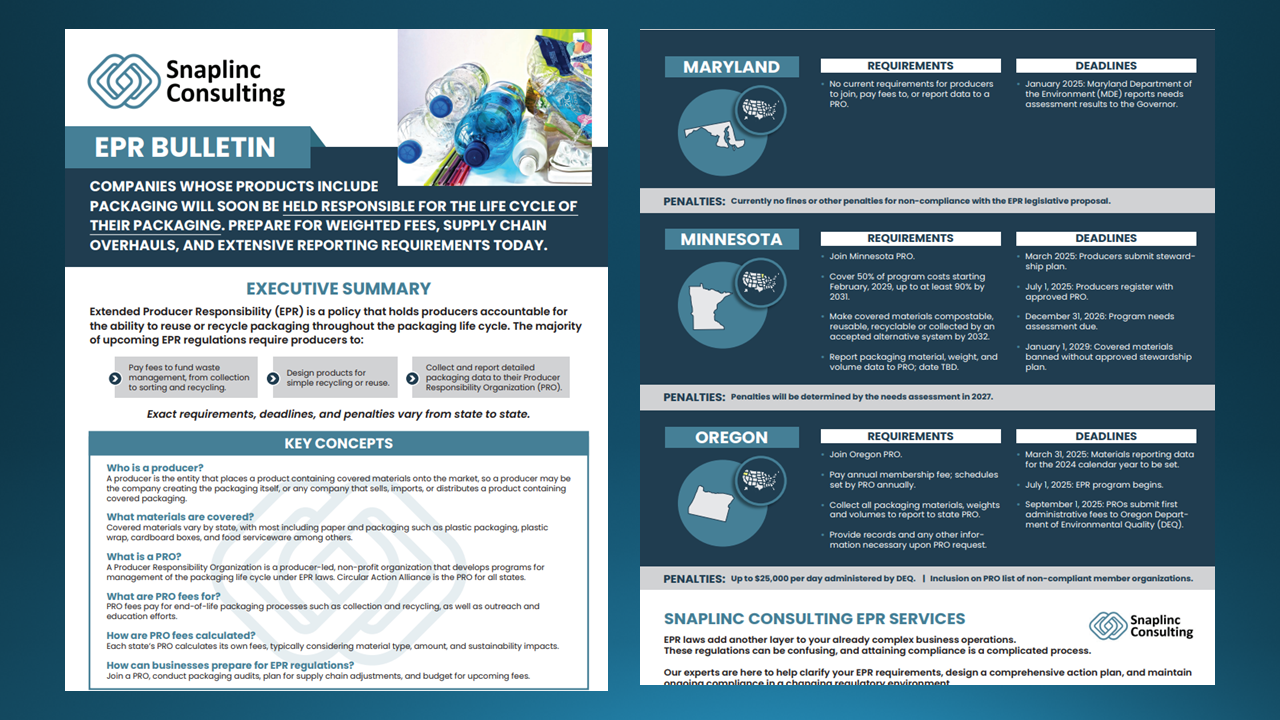
Download our EPR Bulletin
Sign Up to Our Newsletter for News and Updates









Sustainability is no longer a “nice to have.” Customers, investors, and regulators are demanding that businesses prove their commitment to responsible practices. One of the most trusted tools for demonstrating that commitment is EcoVadis, a global sustainability rating platform that is used to share a scorecard with suppliers, who often have minimum expectations for the companies they work with.